Aleatoric in Music Compositions
Compositional Freedom, playful.
In my compositions, I employ aleatoric elements as a deliberate creative tool – a bridge between through-composed structure and spontaneous musical unfolding. The term aleatoricism, derived from the Latin "alea" (dice), describes compositional techniques in which chance or indeterminacy are purposefully incorporated.
The roots of aleatoric composition reach back centuries. As early as the late 15th century, Johannes Ockeghem's "Missa cuiusvis toni" represented an early form of indeterminate music, belonging to the genre of the catholicon. By the late 18th century, the concept had evolved into the "Musikalisches Würfelspiel" – musical dice games attributed to composers such as Carl Philipp Emanuel Bach, Joseph Haydn, and Wolfgang Amadeus Mozart. These games offered multiple versions of individual measures, with dice rolls determining the final sequence of a composition. In the early 20th century, the French artist Marcel Duchamp brought chance procedures into the avant-garde, composing pieces between 1913 and 1915 that were later performed at Dada events in Paris. His contemporaries Francis Picabia and Georges Ribemont-Dessaignes explored similar territory. Decades later, John Cage's "Music of Changes" (1951) became a landmark work largely shaped by random procedures – yet when Cage learned of Duchamp's earlier experiments, he asked him: "How is it that you used chance operations when I was just being born?"
In Nu Fusion, this tradition finds a particularly organic expression: while harmonic progressions, formal structures, and rhythmic foundations are precisely composed, I deliberately open spaces for improvisational freedom and spontaneous interaction. Certain passages emerge only in the moment of recording or performance – through intuitive decisions, free interplay between tracks, or through variation of already composed motifs.
This aleatoricism creates a vital tension: the music retains its structural integrity while simultaneously generating an element of the unpredictable. Each recording becomes a unique event that cannot be exactly reproduced – similar to a live performance, where the energy of the moment helps shape the musical form.
In the tradition of Miles Davis' electric phase or Weather Report, I thus combine compositional precision with improvisational freedom – a working method that corresponds to the spirit of fusion: the merging of apparent opposites into a coherent whole.
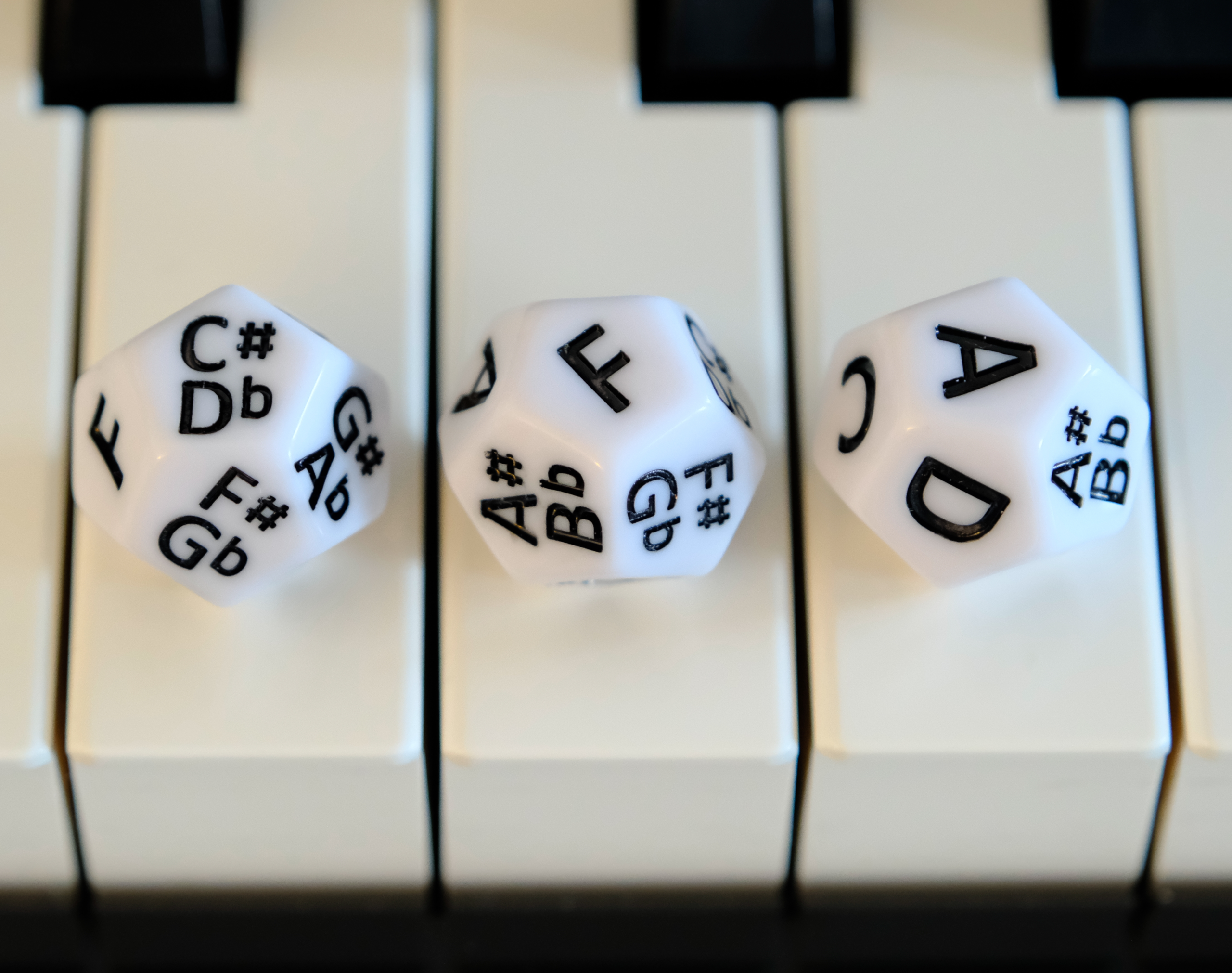
For this purpose, I have designed a dodecahedral dice – a twelve-sided musical dice that serves as a compositional tool. The choice of twelve sides is deliberate: it corresponds to the twelve semitones of the chromatic scale, the twelve major and minor keys, and various other twelve-based structures in music theory. Each face can represent different musical parameters – from key centers and chord qualities to rhythmic subdivisions or formal decisions. This dice transforms the abstract concept of musical chance into a tangible, physical tool that bridges these centuries-old aleatoric traditions with contemporary composition. The dodecahedral dice is available for order through my website, allowing fellow composers and musicians to incorporate systematic chance procedures into their own creative work.